Early this morning i close my EURCHF trade at 1.2072 . Further details of this trade will be published this weekend
Δευτέρα 17 Δεκεμβρίου 2012

Κυριακή 16 Δεκεμβρίου 2012
ENDING MY TRADING FOR 2012
2012 is almost finished and i think its time to close my trading year as well.
I have two trades open:
1) EURCHF which was my strategic yearly trade and
2)AUDUSD which was initiated at the end of November
I will close my EURCHF when markets open on Monday morning and raise my stop loss to break evene for my AUDUSD trade
Next Weekend would be my final update for this year revewing all my trades and how i did
I have two trades open:
1) EURCHF which was my strategic yearly trade and
2)AUDUSD which was initiated at the end of November
I will close my EURCHF when markets open on Monday morning and raise my stop loss to break evene for my AUDUSD trade
Next Weekend would be my final update for this year revewing all my trades and how i did
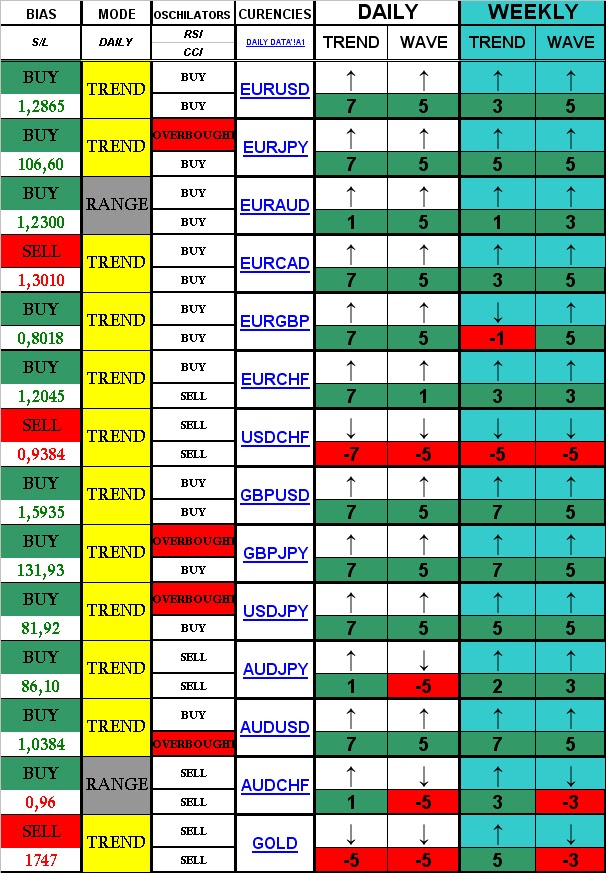
G14 OUTLOOK FOR THE WEEK 17 DEC - 25 DEC
The two main events were the rise in the EURUSD and the significant weakening of the yen. Since we enter in the holiday season i expect that the market will not trade rattional and although i will be wathing i am not expecting moves to make sence since all the big players are standing aside waiting for the new year
EURUSD: The pair finished the week strong climbing to 1.3160 and making all the short players out there to feel very uncomfortable. It remains to see if it can break the remaining1.3180 level which will skyrocket the pair very fast to 1.3480
EURJPY: The pair closed the week at 109.90 !!!! It has climbe a lot and a correction is long overdue. I expect above 110-111 to find a significant resistance and stall for a while. Bias remains bullish
EURAUD:The picture in this pair is gettinbg vlearer this weak . Many indicators have turned bullish and the pair is getting also affected by the stronger euro. My bias is buy with a s/l at 1.2290 . However it is not yet at trend
EURCHF: The pair had a spike at the beginning
of last week reaching close to 1.22. However it then falls again. Although, it
gives some indication that it is getting out of the come is still a very tricky
pair. Someone could play the long side with a s/l at 1.2020 and t/p 1.22
USDCHF: As I have already mentioned
this pair is the alter ego of EURUSD. As a result since EURUSD is rising
this pair is falling and the opposite
GBPUSD: The pair managed to change
to uptrend mode last week. Nonetheless i am not very convinced and i don’t
believe that it has a lot of a potential in the upside. Not very clear
picture for this pair either
USDJPY: The pair have broken form a bulish flag(continuation formation). Having taken out the 83 level is aming the 84.and then 85.50 !
AUDUSD: This pair is also in a buy mode . However, it seems that it has problem to rise as fast as the other risk on pair which make me wonder if the rise is meant to be short lived. Nonethe less i remain bulish as long as it trades above 1.0380!
USDJPY CLOSED SUCCESSFULLY - T/P FILLED +400 PIPS
After 3 months my trade was finally closed . It was a smooth trade and very well behaved allthough it took more time that i was anticipating. Although that many believed that the main driver for yen weakening would be BOJ finally it was political .... Election were announced for 16 December and Noda 's party lost . The new leader is a bold supparter of a further drastic QE


R.DALIO'S INTERVEW ON CHARLI ROSE( NEW YORK TIMES)
 Ray Dalio, founder of Bridgewater Associates.
Ray Dalio, the founder of Bridgewater Associates, didn’t used to do many media appearances. But a series of big magazine profiles that focused on the intense culture of his Connecticut-based hedge fund seem to have eased the billionaire out of his shell.
On Thursday, Mr. Dalio appeared on Charlie Rose‘s program on PBS
to talk about the economy, and to address the accusations that
Bridgewater — which is governed by a set of rules laid out in Mr.
Dalio’s business manifesto, “Principles” — is a cult of personality
“It’s a global macro firm,” said Mr. Dalio, who eschewed his usual
wardrobe of khakis and untucked shirts for a dark suit and red tie.
For more than half an hour, Mr. Rose and Mr. Dalio talked about the
state of the world economy. Mr. Dalio explained his oft-repeated
“deleveraging” theory, in which debts rise relative to incomes in a
nation until the country, under threat of default, takes stimulative
actions to bring the debt-to-income ratio back to more stable levels.
Mr. Dalio told the host he believed the United States is in a
deleveraging process, but said that economic catastrophe could be
averted if careful action is taken.
“The key is to spread it out as much as you can, to make sure it’s not disorderly” Mr. Dalio said of the deleveraging process.
Mr. Rose asked Mr. Dalio, who has pledged to give away at least half his wealth as part of a giving pledge engineered by Warren E. Buffett,
if he supported a so-called Buffett Rule that would raise taxes on the
top income brackets. Mr. Dalio said that he did support the plan, but
that he wanted to make sure his tax money was being put to good use.
“I’m going to give away a lot more than half my money,” said Mr.
Dalio, who made more than $3 billion in 2010. “I’d be happy to give that
to the government if the government put together programs that were
like I’m giving away to charity, in which I believe the money is
effectively used to help people.”
Mr. Dalio defended Bridgewater’s culture, which emphasizes radical
honesty and encourages employees to criticize each other, by saying that
it was “exactly the opposite of a cult.” He said that the firm’s
culture of institutionalized bickering actually made it more productive.
“If people who are disagreeing can say, ‘Why do we disagree?’ and
work through that conversation in an intelligent way to try to find out
what’s true, you can learn, you can make progress,” he said. “It can be a
fabulous thing.”
The Occupy Wall Street
movement, a go-to topic for journalists interviewing financiers since
the protests in Lower Manhattan began, also came up in the segment. Mr.
Dalio said he understood the frustration expressed by the protesters,
but added that he did not believe he had done anything to deserve the
ire of the 99 percent.
“I think I did everything right,” he said. “I did well when others
didn’t. I happen to earn one-fifth of the profits. I pay about a third
in taxes, I give away about a third, and I follow the law. And if I’m
doing something they think is incorrect, I’d like to know that.”
And despite his bearish outlook on the domestic economy, Mr. Dalio ended the interview on a caveat-laden note of hope.
“If we can keep orderly, and not argue with each other, and not do
disruptive things, and we don’t go down,” he said. “Maybe then it’ll be
O.K.”
( http://dealbook.nytimes.com/2011/10/21/bridgewaters-dalio-i-think-i-did-everything-right/)
You can watch the full intervew here
http://www.charlierose.com/view/interview/11957
( http://dealbook.nytimes.com/2011/10/21/bridgewaters-dalio-i-think-i-did-everything-right/)
You can watch the full intervew here
http://www.charlierose.com/view/interview/11957
RAY DALIO-COMMENT ON BARRON
"Barron's:
I can't think of anyone who was earlier in describing the deleveraging
and deflationary process that has been happening around the world.
Dalio: Let's call it a "D-process," which is different than a recession, and the only reason that people really don't understand this process is because it happens rarely. Everybody should, at this point, try to understand the depression process by reading about the Great Depression or the Latin American debt crisis or the Japanese experience so that it becomes part of their frame of reference.
Most people didn't live through any of those experiences, and what they have gotten used to is the recession dynamic, and so they are quick to presume the recession dynamic. It is very clear to me that we are in a D-process..."
Dalio: Let's call it a "D-process," which is different than a recession, and the only reason that people really don't understand this process is because it happens rarely. Everybody should, at this point, try to understand the depression process by reading about the Great Depression or the Latin American debt crisis or the Japanese experience so that it becomes part of their frame of reference.
Most people didn't live through any of those experiences, and what they have gotten used to is the recession dynamic, and so they are quick to presume the recession dynamic. It is very clear to me that we are in a D-process..."
Εγγραφή σε:
Αναρτήσεις (Atom)